Like most modern software, PrestaShop has been available in different versions since its inception, which increment with each update. The versions are named by a sequence of numbers separated by dots, each number indicating a more or less significant update.
Until its version 8, PrestaShop did not quite follow a standard versioning. For example, for version 1.7.6.9 1.7 indicates the major version number, 6 is the minor version number, while 9 is for a patch. With the upgrade to 8 there is no longer any need for 1., the 8 is the major version.
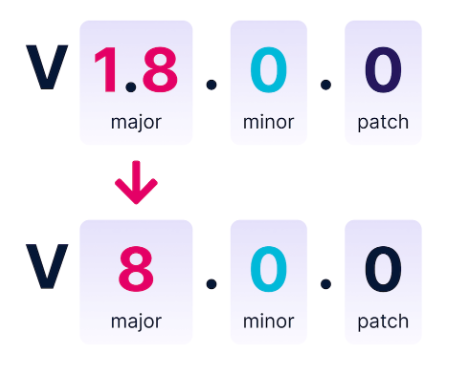
|
📝To go further, you can consult the terms of the versioning standard now used by PrestaShop (it is called "SemVer", an abbreviation of Semantic Versioning): https://semver.org/lang/fr/ |
Since its initial release in 2007, PrestaShop has undergone numerous updates and improvements. Here is an overview of the history of its major versions:
- Prestashop 1,0: this initial version of Prestashop was released in August 2007. It featured basic functionalities for order management, product management, and customer management.
- Prestashop 1.1: released in December 2007, this version added new features, including product image management and language management.
- Prestashop 1.2: released in February 2008, this version added features for tax and carrier management.
- Prestashop 1.3: released in April 2009, this version added features for module and theme management.
- Prestashop 1.4: released in October 2010, this version added features for product category and variant management.
- Prestashop 1.5: released in November 2011, this version introduced a new administration interface and new features for managing orders and customers.
- Prestashop 1.6: released in March 2014, this version added features for managing inventory and orders, as well as performance improvements.
- Prestashop 1.7: released in November 2016, this version introduced a new user interface and new features for managing products, customers, and orders.
- Prestashop 8: released in October 2022, this version is a significant milestone for the project. It marks the beginning of the detachment of the company PrestaShop from the Open Source PrestaShop project, and the transition to compatibility with PHP8.1. Improvements in security and performance are also part of the new features.
- PrestaShop 9: released in June 2025, this version introduces changes that are rather developer- and integrator-oriented, allowing for the solidification of the very foundation of the software. Among the changes are: the transition to Symfony6.4 and up to PHP8.4, a new admin API, a new theme, as well as optimizations of several pages in both the back and front office.
The different versions of PrestaShop are available on our website.
It is recommended to regularly update your version of PrestaShop to benefit from the latest features and security enhancements. However, successfully migrating to a new version is not within everyone's reach. We recommend being accompanied by technical expertise, whether through our expert partners or our technical support.
|
💡 The PrestaShop Hosted offer is based on version 8 of PrestaShop, while the Classic offer is based on version 9. Discover their advantages in this article! |